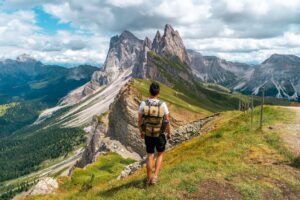
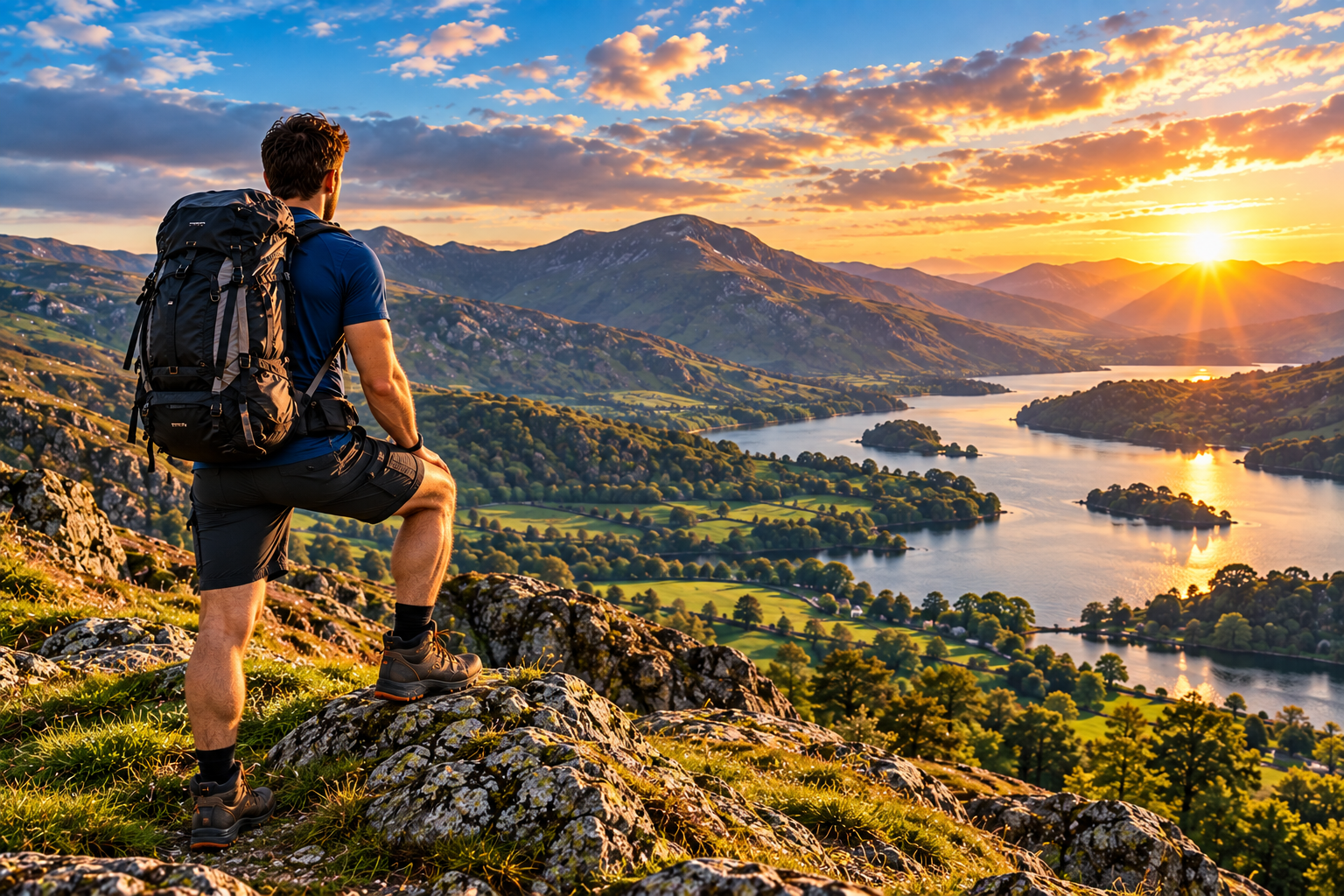
There is something different about walking alone. Without conversation, group decisions or somebody else’s pace to consider, a simple hike can become a genuine adventure. You hear more, notice more and have the freedom to stop whenever a view catches your attention.
For The Solo Gent, solo hiking represents exactly what independent adventure should be: accessible, flexible and rewarding without requiring an enormous budget or weeks away from home.
You do not need to climb Britain’s highest mountains to experience it. Your first solo hike could be a countryside trail, coastal path, forest walk or gentle route through one of the UK’s national parks.
What matters is choosing an adventure suitable for your experience and preparing properly.
Walking with friends can be brilliant, but walking alone offers something completely different.
The most obvious benefit is freedom. There is nobody else deciding when you leave, how quickly you walk or when you stop.
If you discover an incredible viewpoint, you can sit there for half an hour.
If you want to stop for coffee, you stop.
If you are feeling energetic and conditions allow it, you might extend your route. If you are tired or the weather changes, you can shorten the day.
The experience belongs entirely to you.
That independence can be especially refreshing if your normal week is filled with appointments, work, responsibilities and other people’s schedules.
Your first solo hike should not be your hardest hike.
Choose something comfortably within your existing fitness and navigation abilities. You can increase the challenge as your experience develops.
Look at distance, elevation, terrain and expected walking time rather than simply choosing a route because the photographs look spectacular.
Ten miles across relatively flat countryside is very different from ten miles involving steep mountain terrain.
Research where the route starts, where you can park or which public transport services are available, and whether there are toilets, cafés or other useful facilities nearby.
Also identify possible shortcuts or alternative routes.
Having options gives you flexibility if you become tired or conditions deteriorate.
British weather deserves respect.
A beautiful morning can turn wet, windy and cold remarkably quickly, particularly in exposed areas.
Check a reliable forecast before leaving and pay attention to more than the chance of rain. Temperature, wind, visibility and changing conditions can all affect your plans.
Mountain weather can be dramatically different from conditions in nearby towns and valleys.
Be prepared to postpone or change your route when necessary.
There is nothing weak about deciding conditions are unsuitable. Good judgement is an essential outdoor skill.
The trail will still be there another day.
When hiking alone, somebody should know your basic plan.
Tell a trusted person where you are walking, where you expect to start and finish and roughly when you expect to return.
If your plans change significantly, update them where practical.
You can also agree to send a message when you safely finish.
Most solo hikes end without incident, but sharing your plans creates an additional layer of security if something unexpected happens.
Your feet are doing most of the work, so look after them.
Choose footwear appropriate to the route and conditions.
For straightforward dry trails, good walking shoes may be sufficient. Rougher, wetter or more demanding terrain may justify suitable hiking boots.
Whatever you choose, make sure your footwear fits properly and has been worn before your adventure.
A long hike is a terrible place to discover that your new boots rub your heels.
Good walking socks also make a significant difference.
Consider carrying blister treatment in your first-aid kit, particularly on longer routes.
The temperature you experience while climbing uphill can feel very different from the temperature when you stop at an exposed viewpoint.
Layering allows you to adapt.
A typical outdoor clothing system might include a comfortable base layer, insulating mid-layer and waterproof outer layer.
Add or remove clothing as necessary.
Avoid waiting until you are extremely hot before removing a layer or freezing before adding one.
Carry waterproof protection when conditions justify it, even when the weather looks pleasant at the start.
The weather does not care what the forecast looked like when you left home.
Water is one of the heaviest things you will carry, but that does not make it optional.
Take enough for the distance, weather and difficulty of your route.
Hot conditions, strenuous climbs and longer walks naturally increase your requirements.
Do not automatically assume you can refill from a stream. Natural water sources can carry contamination even when the water looks beautifully clear.
If your route depends on natural sources, research appropriate water treatment and availability before setting out.
For many beginner day hikes, carrying the water you need is the simplest option.
Walking burns energy.
Even if you plan to finish before lunch, carrying something to eat is sensible.
Sandwiches, fruit, nuts, cereal bars and similar foods are easy to pack.
Bring something you actually enjoy eating.
A favourite snack can become surprisingly motivating halfway through a long climb.
It is also sensible to carry a small reserve rather than calculating food down to the final mouthful.
If your route passes a good café or country pub, there is nothing wrong with building that into your adventure either.
Solo hiking does not have to mean surviving entirely on trail mix.
Phones have made navigation extraordinarily convenient.
Mapping apps can show your location, route and distance with impressive accuracy.
But batteries die.
Phones get damaged.
Technology fails.
Before undertaking more remote adventures, develop basic navigation skills and carry appropriate backup navigation for the environment.
Understand where your route goes before starting rather than blindly following a line on a screen.
Look at major landmarks, junctions and potential escape routes.
Navigation becomes considerably easier when you maintain awareness throughout the day rather than waiting until you are completely lost.
Because your phone can provide communication, maps, weather information and emergency assistance, preserving its battery is important.
A compact power bank can be extremely useful.
Start your hike with your phone fully charged and consider downloading relevant maps for offline use.
Avoid unnecessarily draining your battery by constantly watching videos or scrolling social media.
The countryside is providing the entertainment.
A small first-aid kit is worth carrying on every hike.
It does not need to fill half your backpack.
Take supplies appropriate to the activity and learn how to use them.
Blisters, small cuts and minor injuries can usually be handled relatively easily when you are prepared.
Personal medication should also be included where required.
For anyone planning regular remote adventures, proper first-aid training is an excellent investment.
An early start provides flexibility.
You have more daylight, quieter trails and additional time if the walk takes longer than expected.
There is also something special about arriving at a popular viewpoint before the crowds.
Pack your equipment the night before.
Prepare food.
Charge your devices.
Check your route.
Then you can wake up, have breakfast and leave without spending an hour looking for your waterproof jacket.
Solo hiking is not automatically a fitness competition.
Walk at a sustainable pace.
You should be able to enjoy your surroundings rather than staring at your watch every five minutes.
If you need a break, take one.
Drink some water.
Eat something.
Look at the landscape.
Unless you have a genuine timing requirement, there is little value in rushing through a beautiful location just to achieve a faster walking speed.
Solo adventures naturally produce photographs worth keeping.
Take them.
Capture the views, unusual details and moments you want to remember.
Then occasionally put the phone away.
Stand somewhere and simply look.
Modern life encourages us to experience everything through a screen. Outdoor adventure provides an opportunity to reverse that habit.
Not every view needs to become a social media post.
Some can simply become memories.
The first few miles of a solo walk can feel unusually quiet.
You might instinctively reach for headphones.
There is nothing wrong with listening to music or a podcast where doing so is safe, but try spending part of the walk without them.
Listen to the environment.
Birds, streams, trees and weather create their own soundtrack.
You may be surprised how quickly silence stops feeling empty.
It becomes one of the reasons you go.
Reaching your planned destination can feel important, particularly if you have travelled a long way to attempt the route.
But the summit, viewpoint or final mile is optional.
Getting home safely is not.
If conditions deteriorate, you become unwell, navigation becomes uncertain or something simply feels wrong, reconsider your plan.
Turning around can be the correct decision.
Experienced outdoor enthusiasts understand that abandoning an objective does not mean the day was wasted.
You still spent time outside.
You still gained experience.
And you can return.
Solo adventure does not mean you own the trail.
Be considerate of walkers, runners, cyclists, landowners and local communities.
Follow signs and access requirements.
Keep noise reasonable.
Leave gates as required.
Control interactions with livestock appropriately and follow local guidance.
Outdoor spaces work because people share them responsibly.
Take your rubbish home.
That includes food packaging, tissues and anything else you brought with you.
Avoid disturbing wildlife or damaging plants.
Stay on appropriate routes where required and follow restrictions designed to protect sensitive areas.
The goal should be to leave the landscape as good as—or better than—you found it.
Responsible adventure allows everybody to continue enjoying these places.
Once you have gained confidence, consider planning a sunrise adventure.
There is something extraordinary about walking while most people are still asleep and reaching a viewpoint as daylight appears.
Preparation matters more because part of your route may be completed in darkness.
Carry a reliable headtorch, understand the route and choose somewhere appropriate to your experience.
The reward can be spectacular.
A familiar landscape can look completely different in the first light of morning.
Britain’s coastline provides enormous opportunities for solo walking.
Cliffs, beaches, fishing villages and coastal paths can create the feeling of a major adventure without requiring mountain terrain.
Coastal walking has its own hazards, however.
Stay away from unstable cliff edges, understand tide-related risks where relevant and respect closures and warning signs.
Research your route before leaving.
A walk that combines spectacular scenery with lunch in a seaside town can make an excellent first solo weekend adventure.
Not every adventure needs huge views.
Woodland walking offers a completely different atmosphere.
Forests can be particularly beautiful during autumn when colours change and paths become covered in leaves.
Established woodland routes are often excellent for beginners because they can provide clearly marked trails and a variety of distances.
They can also be good locations for developing navigation skills in relatively controlled surroundings.
The UK has an extraordinary variety of protected landscapes offering countless walking possibilities.
National parks can provide mountains, moorland, woodland, valleys, lakes and coastline depending on where you travel.
Research official information before visiting, particularly parking, access restrictions, seasonal conditions and route difficulty.
Do not assume that a famous route is automatically suitable for beginners.
Choose according to your ability rather than popularity.
The adventure does not necessarily begin at the trailhead.
Stop somewhere interesting on the journey.
Find a good breakfast.
Explore a village after finishing.
Book a campsite and turn the walk into an overnight trip.
Once you start thinking this way, a simple day hike can become an entire weekend away.
That is one of the strengths of solo travel.
You can build the experience exactly how you want it.
You do not need anything complicated.
Record the date, location, distance and general conditions.
Write down what you enjoyed and what you would change.
Perhaps your backpack felt uncomfortable after six miles.
Maybe you needed more water.
Perhaps a particular jacket performed brilliantly in the rain.
These notes gradually improve your planning.
They also become a record of everywhere you have explored.
After a few years, looking back through dozens of adventures can be incredibly satisfying.
Once your first few walks feel comfortable, expand your experience.
Try a longer route.
Add more elevation.
Walk during a different season.
Combine hiking with camping.
Learn more advanced navigation.
Explore somewhere farther from home.
Progress gradually rather than jumping from a gentle countryside walk directly into demanding mountain terrain.
Confidence built through experience tends to last.
There is sometimes a strange idea that adventure must involve danger to count.
It does not.
The best solo adventurers prepare carefully precisely because they understand that nobody else is immediately available to solve their problems.
Check conditions.
Carry appropriate equipment.
Know your limitations.
Change plans when necessary.
Preparation does not reduce adventure.
It gives you the confidence to enjoy it.
For your first adventure, keep things straightforward.
Choose a manageable route somewhere you genuinely want to explore.
Check the forecast.
Pack water, food, suitable clothing, navigation equipment, basic first aid and a charged phone.
Tell somebody where you are going.
Then start walking.
Do not worry about breaking records.
Stop when you want.
Take photographs.
Find a viewpoint.
Eat your lunch somewhere beautiful.
Enjoy having nowhere else you need to be.
When you return home, you may discover that the most satisfying part was not the distance or destination.
It was the simple fact that you decided to go and made the adventure happen yourself.
Independent adventure is not about avoiding other people. It is about knowing that your plans do not always depend on somebody else being available.
Friends can join the next trip.
This one can belong to you.
A free Saturday, a backpack and a walking route are sometimes all you need.
Start locally. Build your skills. Respect the outdoors. Travel responsibly.
Then gradually go farther.
The Solo Gent is about making independence part of the adventure—one trail, one weekend and one destination at a time.

I’m the voice behind The Solo Gent, sharing my interest in solo adventures, camping and the freedom to explore at my own pace.
This blog is a place for practical ideas and honest inspiration. I write about planning trips, choosing gear and finding worthwhile adventures both close to home and farther afield. You don’t need to be an expert or travel for weeks to begin—sometimes a single night camping or a new walking route is enough.
If you’re ready to make the journey your own, welcome to The Solo Gent.