Solo camping can be one of the most rewarding ways to experience the outdoors. You choose where to go, when to stop, what to eat and how you want to spend your time. There is no need to organise a group or wait for somebody else’s schedule. You simply pack your equipment and head out on your own adventure.
That freedom, however, comes with additional responsibility.
When you camp alone, there is nobody beside you to lend you forgotten equipment, help pitch a troublesome tent or immediately notice when something has gone wrong. Good preparation becomes particularly important.
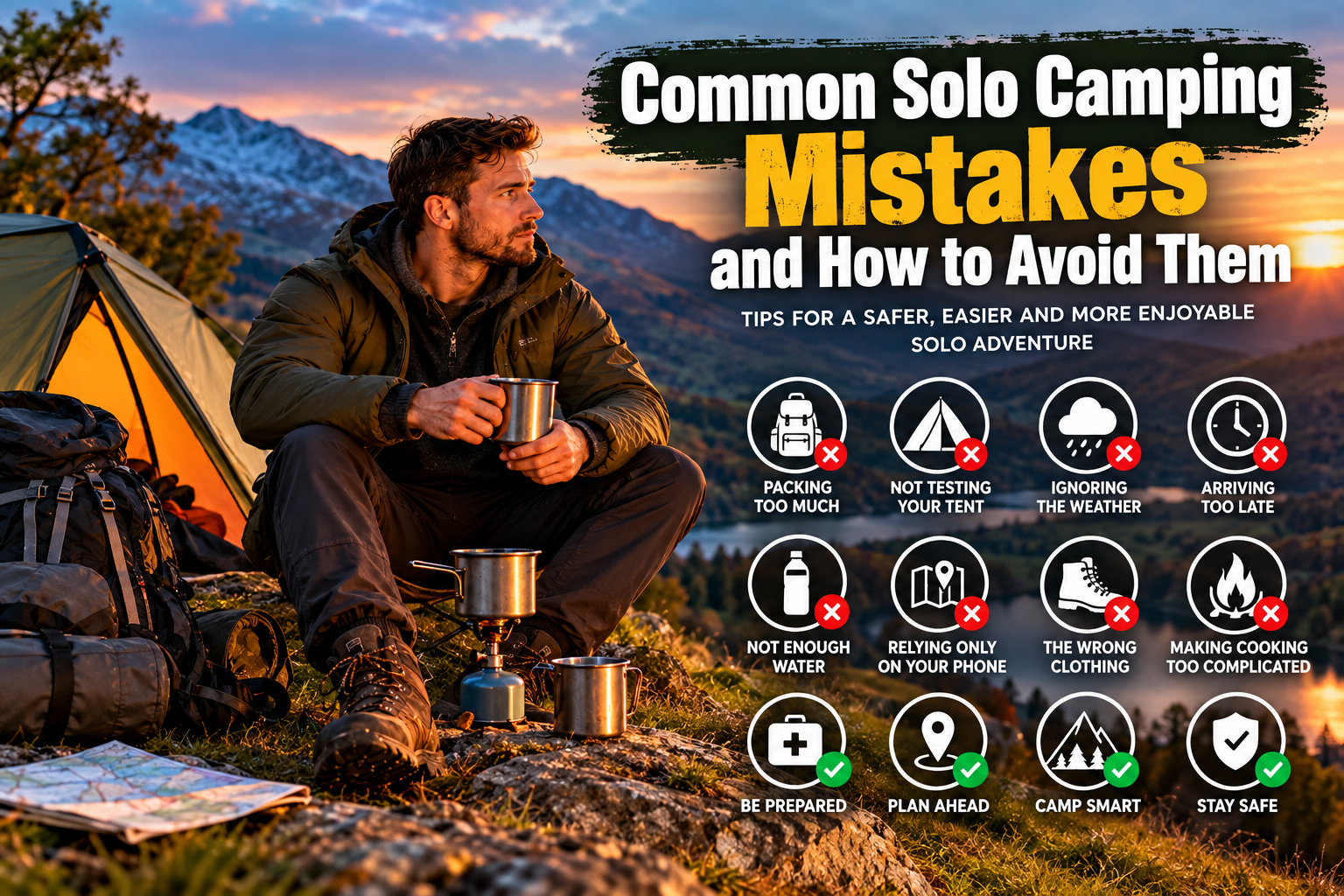
Fortunately, many problems experienced by new solo campers are predictable and preventable. From carrying too much equipment to arriving at camp after dark, small mistakes can turn an enjoyable weekend into an uncomfortable experience.
Whether you are preparing for your first night alone or already have a few trips behind you, this guide from The Solo Gent looks at some of the most common solo camping mistakes and explains how to avoid them.
One of the easiest mistakes to make as a beginner is packing for every imaginable situation.
Extra clothes, multiple cooking pans, unnecessary gadgets, oversized toiletries and “just in case” items quickly accumulate. Before long, your backpack feels as though you are preparing for an expedition rather than a weekend away.
The problem becomes obvious once you start walking.
A heavy pack can make the journey less enjoyable and leave you exhausted before you even reach your campsite.
Before packing, consider what you genuinely need for the length, location and conditions of your trip. Create a checklist divided into shelter, sleeping equipment, clothing, cooking, food, water, navigation, safety and personal items.
After packing everything, review it again.
If you cannot explain why an item needs to come with you, consider leaving it behind.
The goal isn’t necessarily to become an ultralight camper. It is simply to carry equipment that has a useful purpose.
Taking too much is a problem, but forgetting something important can be worse.
Tent pegs, a sleeping mat, waterproof clothing, medication, a headtorch or the correct stove equipment can make a significant difference to your trip.
Use a camping checklist rather than relying entirely on memory.
Start packing a day or two before departure if possible. This gives you time to identify missing items rather than discovering them shortly before leaving.
For important equipment, physically check that it is inside your bag.
A checklist is simple, but it is one of the most effective habits a solo camper can develop.
A new tent can look straightforward when you watch somebody else pitch it.
Reality can be different when you arrive at your campsite with unfamiliar poles, clips and guy lines.
Before your first trip with a tent, practise setting it up at home or somewhere suitable.
Learn which pole goes where, how the flysheet attaches and how the guy lines should be tensioned. Check that all the required components are present.
You should ideally be able to pitch your shelter without constantly referring to the instructions.
This becomes especially valuable when the weather turns unpleasant.
Setting up a familiar tent in light rain is inconvenient. Trying to understand an unfamiliar tent for the first time in wind and darkness can be considerably more difficult.
There is something appealing about arriving at a campsite around sunset, but beginners should give themselves plenty of daylight.
Setting up camp involves more than pitching a tent. You need to assess the ground, organise your sleeping equipment, prepare food, locate facilities and familiarise yourself with the surroundings.
Doing all of this becomes harder after dark.
Try to arrive early enough that you are completely organised before sunset.
Once your campsite is ready, you can relax, make something to eat and enjoy the evening rather than rushing around with a headtorch.
Not every flat-looking piece of ground makes a good campsite.
A beginner might pitch in the lowest part of a field because it appears sheltered, only to discover that rainwater collects there. Another camper might choose an exposed position and spend the entire night listening to the tent being battered by the wind.
Look at your surroundings before pitching.
Choose reasonably level, well-drained ground and consider how exposed you are to wind. Avoid obvious dips where water could accumulate.
Look above you as well as around you. Do not camp underneath unstable trees or dead branches.
On an established campsite, follow the site’s pitching rules and use designated areas where required.
A few minutes spent assessing your pitch can save hours of discomfort later.
Never assume tomorrow’s weather will resemble today’s.
UK weather can change rapidly, particularly during autumn and winter and in exposed or elevated locations.
Check the forecast before leaving and continue monitoring conditions where practical.
Pay attention to more than temperature. Rain, wind speed, overnight temperatures and official weather warnings can all affect your plans.
Your equipment should be appropriate for the conditions expected.
Most importantly, be willing to change your plans.
Postponing a trip because the conditions exceed your experience or equipment isn’t failure. It is sensible decision-making.
There will always be another weekend.
A pleasant afternoon can turn into a surprisingly cold night.
This is especially relevant during spring and autumn, when daytime sunshine can create a false sense of security.
Check the expected overnight temperature and make sure your sleeping system is suitable.
That means considering both your sleeping bag and sleeping mat.
A warm sleeping bag cannot completely compensate for inadequate insulation beneath you. The ground can draw heat away from your body throughout the night.
Take suitable sleeping clothes and keep them dry.
If temperatures are likely to fall below what your equipment can comfortably handle, use different equipment or reconsider the trip.
Jeans and an everyday hoodie may be comfortable at home, but outdoor conditions can demand something more suitable.
A layering system allows you to adapt as conditions change.
A base layer helps manage moisture, an insulating layer provides warmth, and an appropriate outer layer protects against wind and rain.
Avoid becoming unnecessarily sweaty while hiking or setting up camp. Remove layers when you become too warm and add them again before you become cold.
Always have a plan for rain.
Even if the forecast looks relatively dry, suitable waterproof protection can be invaluable when the weather changes unexpectedly.
Moisture can transform an otherwise manageable camping trip into an uncomfortable one.
Protect important equipment inside your backpack using appropriate waterproofing. Pay particular attention to your sleeping bag, spare clothing and anything else that needs to remain dry.
Consider keeping a dedicated set of clothes for sleeping.
After a wet day, changing into dry clothing before climbing into your sleeping bag can make an enormous difference.
Do not allow wet boots or clothing to soak your sleeping equipment inside the tent.
Managing moisture is one of those camping skills that becomes increasingly important as the temperature falls.
Never assume you will automatically find safe drinking water.
How much you need depends on your trip, weather, physical activity and access to reliable water supplies.
Plan your water before leaving.
If you intend to refill during your trip, know where legitimate supplies are located and understand any appropriate treatment requirements for the water source you’re considering.
Remember that water isn’t only needed for drinking. You may also need it for cooking and other essential camp tasks.
Running short of water can become much more serious than simply feeling thirsty.
Your first solo camping trip probably isn’t the ideal time to prepare a restaurant-style three-course meal.
Simple food is usually easier.
Choose meals that are straightforward to prepare with your camping equipment and provide enough energy for your activities.
Porridge, pasta, rice dishes, soups and other uncomplicated meals can all work well depending on your preferences and facilities.
Remember snacks too.
If you have been walking for several hours, having something readily available can be useful before you prepare your main meal.
And never use a camping stove or barbecue inappropriately inside your tent. Follow the manufacturer’s safety instructions and maintain suitable ventilation.
Smartphones are incredibly useful for navigation, communication, weather forecasts and photography.
That doesn’t mean they are infallible.
Batteries run out. Phones get wet. Screens break. Mobile reception disappears.
Download important information for offline use where appropriate and carry suitable backup navigation for the environment you are entering.
A power bank can also be useful, particularly on longer trips.
Your phone should be an important tool, not your entire safety strategy.
A phone torch might seem adequate until you need both hands to cook, adjust your tent or find something inside your backpack.
A headtorch is one of the simplest and most useful pieces of camping equipment.
It allows you to work with both hands while illuminating whatever you are looking at.
Check it before leaving and carry appropriate spare power or another backup light.
During autumn and winter, when daylight hours are shorter, reliable lighting becomes even more important.
Independence doesn’t mean disappearing without telling anybody.
Before a solo trip, let a trusted person know where you intend to go, where you expect to stay and when you expect to return.
For more remote adventures, your plan should become more detailed.
If your plans change significantly, update your contact when practical.
This simple precaution means somebody has useful information if you fail to return when expected.
Confidence is useful. Overconfidence isn’t.
A common beginner mistake is choosing an adventure based on how impressive it sounds rather than whether it matches current skills.
Your first solo camping experience does not need to involve remote mountains, extreme weather or a huge walking distance.
Start somewhere manageable.
An established campsite can be an excellent introduction because it allows you to learn how your equipment works while remaining relatively close to facilities.
As your experience grows, gradually increase the challenge.
There is no need to prove anything.
Minor problems can become extremely inconvenient when you’re alone.
Carry a first-aid kit appropriate for your activity and, importantly, understand how to use what is inside it.
Taking a first-aid course can be a valuable investment for anybody who regularly spends time outdoors.
Your kit should complement good judgement rather than create false confidence.
If an injury or illness is serious, seek appropriate professional assistance.
A tidy campsite isn’t simply about appearance.
Food packaging and rubbish can attract animals, create smells and damage the environment.
Store food appropriately and follow the campsite or land manager’s guidance.
Take your rubbish away with you when disposal facilities aren’t available.
Try to leave your camping area as you found it, or better.
Responsible camping helps ensure that outdoor spaces remain enjoyable for everyone.
Solo camping can provide peace and quiet, but remember that other people may be looking for exactly the same thing.
Keep noise at a reasonable level, particularly at night and early in the morning.
Respect people’s pitches and personal space.
If you are listening to music, consider headphones where appropriate rather than making the entire campsite listen with you.
Being considerate costs nothing and creates a much more pleasant atmosphere.
Social media can make solo adventures look like a continuous sequence of dramatic sunsets, perfect campfires and mountain views.
Real camping includes quieter moments.
It may rain. You might spend an hour inside your tent. Your dinner might be average. The sunset might disappear behind grey cloud.
That’s fine.
Part of solo camping is learning to appreciate the slower experience.
Take a book, write a journal, photograph the landscape or simply sit outside with a hot drink.
You don’t need constant entertainment.
The quiet is part of the adventure.
One of the most important lessons in solo camping is knowing when to change the plan.
If the weather becomes dangerous, your equipment fails, you become unwell or something simply doesn’t feel safe, you can leave.
Turning back is not a failed adventure.
Good outdoor judgement involves continually assessing conditions and making decisions based on the information available.
The campsite will still be there another day.
Keep your first trip simple.
Choose somewhere reasonably close to home, use an established campsite and consider staying for one night rather than immediately planning a week-long expedition.
Check your equipment beforehand, arrive during daylight and give yourself plenty of time to set up.
Prepare an easy evening meal, organise your equipment before darkness falls and enjoy having nowhere else you need to be.
Your first trip is an opportunity to learn.
You will quickly discover which equipment you love, which items you never use and what you wish you had packed.
Write those observations down after returning home.
Your second trip will already be better.
One of the best parts of solo camping is the confidence that develops naturally.
The first time you pitch your tent alone, cook your evening meal and settle down for the night, everything may feel unfamiliar.
Then morning arrives.
You make breakfast, pack your equipment and realise you managed the entire experience yourself.
The next adventure feels easier.
Over time, you become better at judging weather, organising equipment, choosing campsites and dealing with small problems.
That confidence can extend beyond camping.
Solo adventures remind you that you don’t always need somebody else to make plans happen. Sometimes you can simply decide where you want to go and start preparing.
That sense of independence is at the heart of The Solo Gent.
Most solo camping mistakes are avoidable.
Pack carefully without taking your entire house with you. Test your equipment before leaving. Check the weather. Arrive before dark. Keep your sleeping equipment dry, carry enough food and water, and make sure somebody knows your plans.
Most importantly, start at a level appropriate for your experience.
Solo camping isn’t a competition to see who can travel furthest or tolerate the worst conditions. It is an opportunity to enjoy the outdoors on your own terms.
Mistakes will occasionally happen, and that is part of learning. What matters is recognising them, adapting and making the next trip better.
With sensible preparation and experience, camping alone can become one of the most enjoyable ways to escape everyday routines and explore more of the outdoors.
Pack your tent. Choose somewhere new. Take your time.
Your next solo adventure is waiting.
The Solo Gent — Adventures, Camping & Independent Living.

I’m the voice behind The Solo Gent, sharing my interest in solo adventures, camping and the freedom to explore at my own pace.
This blog is a place for practical ideas and honest inspiration. I write about planning trips, choosing gear and finding worthwhile adventures both close to home and farther afield. You don’t need to be an expert or travel for weeks to begin—sometimes a single night camping or a new walking route is enough.
If you’re ready to make the journey your own, welcome to The Solo Gent.