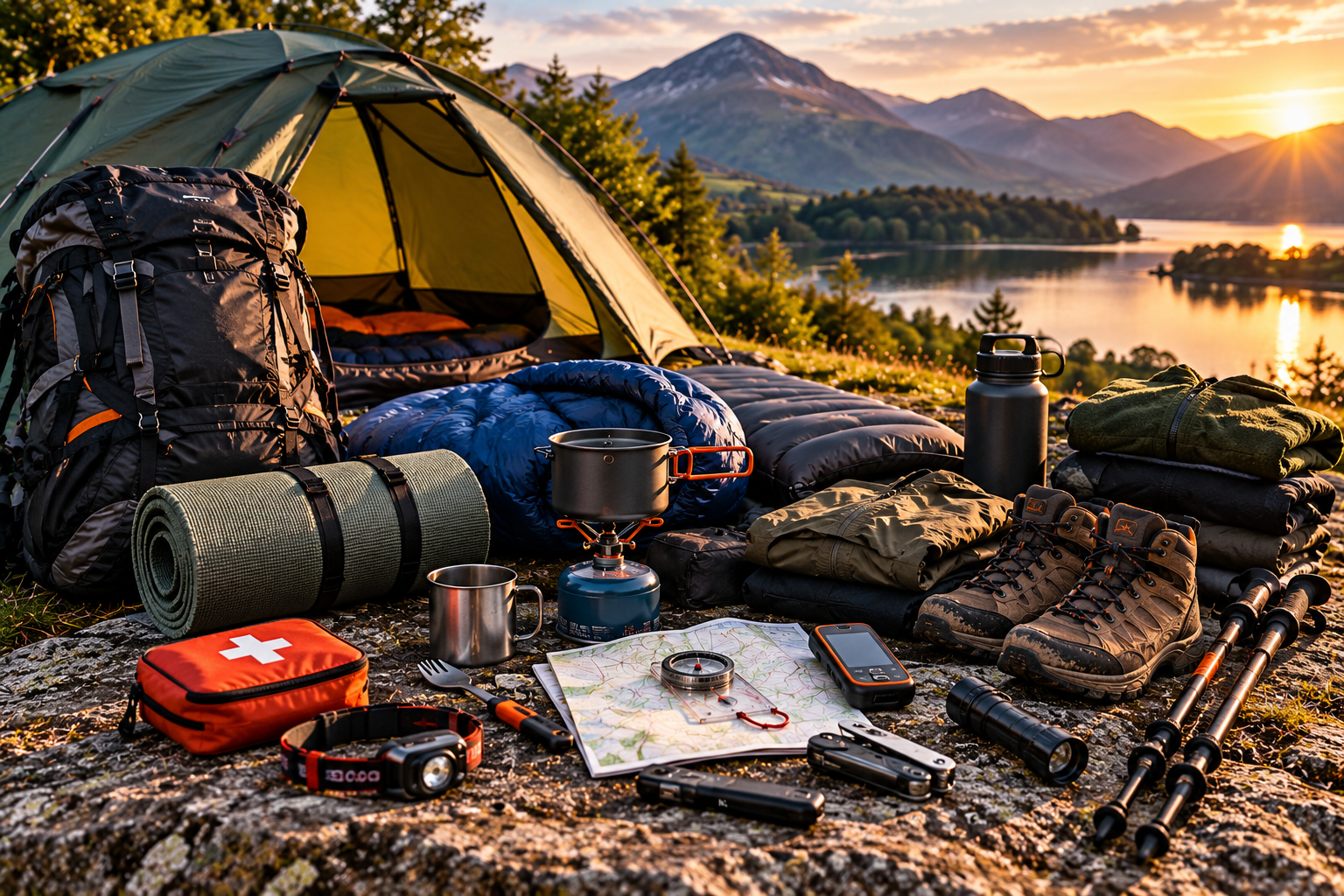
Camping equipment can become complicated very quickly. Walk into an outdoor shop or browse online and you will find hundreds of tents, sleeping bags, mats, stoves, backpacks, torches, chairs, cookware sets and gadgets promising to transform your next adventure.
For a beginner, the amount of choice can be overwhelming.
The truth is simpler. Successful solo camping does not depend on owning everything. It depends on carrying the right equipment for your destination, weather, activity and level of experience.
A carefully selected camping setup gives you shelter, warmth, food, water, navigation, safety and enough comfort to enjoy being outdoors. Everything else should justify the weight, cost and space it occupies.
Your tent is your temporary home.
For solo camping, a one-person tent offers the advantage of reduced weight and packed size. A small two-person model provides additional room for equipment and can feel more comfortable when poor weather keeps you inside.
Consider where you will actually use it.
A tent designed for occasional summer campsite weekends does not need the same specification as equipment intended for exposed backpacking trips.
Look at waterproofing, ventilation, construction, packed dimensions and weight. Pay attention to porch or vestibule space because this gives you somewhere to store muddy footwear and other equipment outside your sleeping area.
Most importantly, practise pitching your tent before your trip.
A poor night’s sleep can ruin an otherwise excellent camping trip.
Your sleeping bag should match expected temperatures. Do not buy purely according to the season label printed on the packaging. Examine the manufacturer’s temperature information and consider whether you personally tend to sleep warm or cold.
Down sleeping bags can provide excellent warmth relative to weight and pack size but require appropriate care. Synthetic bags can be practical, affordable and more forgiving in damp conditions.
Whichever type you choose, keep it dry.
A sleeping bag is one piece of equipment where saving a small amount of money is rarely worthwhile if it results in repeatedly uncomfortable nights.
The humble sleeping mat is one of the most underrated pieces of camping equipment.
It provides cushioning, but more importantly, an appropriate mat helps insulate you from the ground.
Inflatable mats can provide excellent comfort and compact packing dimensions. Foam mats are simple, durable and inexpensive. Self-inflating options sit somewhere between the two.
Your ideal choice depends on whether you prioritise weight, comfort, durability or price.
For car camping, a larger comfortable mat may be worth carrying. Backpackers usually need to balance comfort against weight.
If you are carrying your equipment any significant distance, backpack fit matters enormously.
The correct capacity depends on the amount and type of equipment you carry. Buying an enormous backpack can encourage overpacking, while something too small results in equipment hanging awkwardly from every strap.
Fit is more important than brand.
A properly adjusted pack should transfer much of the load effectively rather than leaving everything hanging from your shoulders.
Load heavier items sensibly and keep frequently used equipment accessible.
Practise packing at home. The first time you discover that everything does not fit should not be ten minutes before departure.
In Britain, waterproof clothing is not an optional luxury for many outdoor trips.
A suitable waterproof jacket provides protection against rain and wind while allowing you to adjust your other layers underneath.
Waterproof trousers can be extremely useful on longer walks or particularly wet trips.
Keep waterproof equipment accessible. Burying your jacket underneath your sleeping bag at the bottom of your backpack means you will already be soaked by the time you retrieve it.
Outdoor clothing works best as a system.
A base layer helps manage moisture. A mid-layer provides insulation. Your outer layer protects against weather.
This arrangement allows you to add or remove clothing as activity levels and temperatures change.
Pack a warm layer for evenings even when daytime temperatures look pleasant. Once you stop walking and the sun disappears, temperatures can feel dramatically cooler.
A dry pair of socks can also feel like luxury after a wet day.
Every solo camper needs reliable lighting.
A headtorch is particularly useful because it leaves both hands free for pitching a tent, cooking or organising equipment.
Carry spare batteries if your model uses them or ensure rechargeable equipment has sufficient capacity.
Your phone torch is useful as a backup, but relying on your phone for every task consumes battery power that may be valuable for communication or navigation.
A compact camping stove makes hot meals and drinks possible almost anywhere that stove use is permitted and safe.
Choose a stove suitable for the type of camping you plan to do and learn to operate it properly before leaving home.
You will also need appropriate fuel, a lighter or ignition method, cookware and something to eat with.
Keep the system simple.
A single pot and spoon can handle an impressive number of camping meals.
Never use equipment that produces combustion gases inside an enclosed tent. Follow the manufacturer’s safety instructions.
Carry reliable bottles or hydration equipment.
How much capacity you need depends on the trip and access to safe water.
For campsite camping, refilling is usually straightforward. Remote backpacking requires greater planning.
If you plan to use natural water sources, research suitable treatment methods for the location and circumstances.
Do not assume that mountain water is safe simply because it appears clean.
Phones have transformed outdoor navigation, but technology can fail.
Download maps for offline access where appropriate and carry a power bank.
For remote routes, learn how to use traditional navigation equipment appropriate to the environment.
More important than owning navigation equipment is actually understanding it.
Practise before you depend on those skills in poor visibility.
A compact first-aid kit belongs in every solo camping setup.
Its exact contents should reflect the trip, but carrying equipment is only useful if you understand how to use it.
Consider basic first-aid training, particularly if you plan increasingly remote adventures.
Also include any personal medication you require.
Modern camping may be about escaping technology, but your phone remains valuable for communication, navigation, weather information, bookings and emergencies.
A charged power bank provides inexpensive reassurance.
Keep electronics protected from moisture.
For longer trips, think about energy use rather than assuming an enormous battery solves everything. Reducing screen brightness and unnecessary background activity can extend phone life significantly.
Camping equipment occasionally breaks.
A small repair kit containing items appropriate to your equipment can rescue a trip.
Depending on your setup, this might include repair tape, tent patches, cable ties or equipment-specific repair materials.
You do not need to carry an entire workshop.
The aim is simply to handle minor failures well enough to continue safely.
Camping does not require abandoning basic hygiene.
Pack a toothbrush, toothpaste, hand sanitiser and any other essentials appropriate to the trip.
Keep toiletries small and avoid carrying full-size bathroom products for one night.
Follow local guidance for human waste and never leave wipes, tissues or other rubbish behind.
Not every item needs to serve a survival purpose.
If you are camping at a site and weight is not a major concern, a comfortable chair can transform the evening.
A camping pillow might be worth its tiny amount of space.
A book can provide entertainment without consuming battery power.
Camping should be enjoyable. There is no prize for deliberately being uncomfortable.
Your food should match your cooking setup.
For a one-night trip, keep things straightforward.
Take food you know you like and that can be prepared easily. Include snacks that require no cooking.
Remember that food packaging becomes rubbish that you must carry out. Repackaging items at home can sometimes reduce unnecessary bulk, provided food remains safely stored and identifiable.
Before a solo trip, make sure somebody knows your plan.
You might also keep key contact and medical information somewhere accessible.
For remote adventures, consider whether additional communication equipment is appropriate.
Equipment should support good decision-making, not replace it.
One of the easiest beginner mistakes is spending hundreds or thousands of pounds before discovering what kind of camping you actually enjoy.
Start with reliable essentials.
Borrow or hire equipment when practical.
Complete a few trips and notice what you want to change.
Perhaps lightweight backpacking becomes your passion, in which case reducing equipment weight becomes important. Perhaps you discover that you prefer comfortable campsites reached by car, making ultralight equipment far less relevant.
Buy for the adventures you actually take.
A good camping setup evolves.
Replace equipment when you understand why the replacement will improve your experience.
Maybe your next purchase is a warmer sleeping bag. Later it could be a lighter tent, better waterproof jacket or more comfortable backpack.
Each improvement should solve a real problem.
That approach saves money and produces a camping kit tailored to you.
Good equipment can last for years when properly maintained.
Dry your tent thoroughly before storing it.
Air and store sleeping equipment according to manufacturer recommendations.
Clean mud from footwear.
Check equipment after each trip so damage can be repaired before you need it again.
There is nothing worse than discovering a broken tent component when you arrive at your destination.
Eventually you will develop a repeatable packing checklist.
Divide it into categories such as shelter, sleep, clothing, food, water, navigation, safety, hygiene and optional comfort.
Use it before every trip.
Experienced campers still forget things. A checklist removes unnecessary reliance on memory.
A £600 tent is not automatically better for you than a £150 tent you can pitch confidently.
An advanced navigation device provides little value if you do not understand it.
Familiarity matters.
Use your equipment. Test it. Practise with it. Discover its limitations.
When bad weather arrives, you should know exactly how your waterproofs perform, how quickly your shelter can be pitched and where your headtorch is stored.
That knowledge creates confidence.
Building your first solo camping setup should be exciting rather than overwhelming.
Focus on the fundamentals: reliable shelter, a suitable sleeping system, weather-appropriate clothing, food, water, lighting, navigation, communication and basic safety equipment.
Add comfort where it genuinely improves your experience.
Ignore the temptation to own every outdoor gadget on the internet.
The purpose of camping equipment is not to sit perfectly organised in a cupboard. It exists to help you get outside.
Build your kit, learn how to use it and start planning the next adventure.
That is the Solo Gent way: practical equipment, independent travel and more time outdoors.

I’m the voice behind The Solo Gent, sharing my interest in solo adventures, camping and the freedom to explore at my own pace.
This blog is a place for practical ideas and honest inspiration. I write about planning trips, choosing gear and finding worthwhile adventures both close to home and farther afield. You don’t need to be an expert or travel for weeks to begin—sometimes a single night camping or a new walking route is enough.
If you’re ready to make the journey your own, welcome to The Solo Gent.